

How can local governments scale AI without exposing sensitive data?
Local governments are under growing pressure to adopt AI. The promise is real: faster casework, better constituent service, more efficient operations. But the work itself runs on information that cannot be exposed. Case records, financial information, public health data, personally identifiable details about residents.
Most AI rollouts treat productivity and protection as competing priorities. They don’t have to be.
Secure AI adoption in local government means deploying AI across departments while protecting sensitive information at the point of use, before it reaches the model. It requires four things: defined policies for every category of protected data, a technical layer that enforces those policies inside the prompt, a controlled pilot that validates both, and expansion driven by employee demand rather than mandate. Governments that skip the enforcement layer are relying on policy alone, which governs intent but not behavior.
Point-of-use protection means detecting and handling sensitive information within the prompt before it is sent to an AI model, then restoring that information in the response. Employees get useful output. Protected data never leaves the organization’s control.
This post offers a practical framework for achieving that, based in part on Prince William County, Virginia’s secure AI deployment. What started as a 150-user pilot has grown to 20+ departments, driven not by mandate but by employees encouraging colleagues to join.
Why do government AI bans fail to protect sensitive data?
In most government organizations, employees are already finding ways to use generative AI. Consumer tools are freely available. The productivity gains are obvious. Waiting for permission is rarely the default behavior.
This creates a problem that policy alone cannot solve.
Blanket bans push usage underground. Employees use personal devices, unmonitored browsers, or unsanctioned tools. The data exposure risk doesn’t disappear; it becomes invisible to IT and leadership.
The research bears this out. In a global study of 48,340 workers across 47 countries conducted by the University of Melbourne and KPMG, 57% said they conceal their AI use at work and present the output as their own. Nearly half had already uploaded company data into public AI platforms. Prohibition produced concealment, not compliance.
Source: Trust, attitudes and use of artificial intelligence: A global study 2025, University of Melbourne and KPMG.
Public-sector security leaders are absorbing this problem as their responsibility expands. In the 2026 NASCIO-Deloitte Cybersecurity Study, 94% of state CISOs reported active involvement in developing generative AI security policies, and the share overseeing agency adoption of emerging technologies rose from 38% in 2022 to 69% in 2026. Over the same period, confidence in the ability to protect state data against threats fell from 48% to 22%, while a growing share of CISOs reported budget reductions. Governance responsibility expanded faster than the resources to meet it.
Source: 2026 NASCIO-Deloitte Cybersecurity Study.
Blanket access is equally untenable. Sensitive resident data flowing into third-party AI systems creates compliance exposure, records management challenges, and real harm if that information surfaces where it shouldn’t.
The gap is at the point of use: the moment an employee types a prompt. Policies govern intent. Protection mechanisms govern behavior. Without something that enforces policy in that moment, organizations are relying on every employee to make the right judgment, every time, under deadline pressure, with no safety net.
That model doesn’t scale. The organizations getting AI adoption right are the ones that made the safe path the default path.
Related: the complete guide to enterprise AI governance, including a section on governance priorities for government and public sector.
The Governed AI Rollout Framework: five stages for secure government AI
The Governed AI Rollout Framework is a five-stage sequence for scaling AI across local government: define sensitive data policies, deploy point-of-use protection, run a controlled pilot, validate with stakeholders, and expand through employee-driven adoption. Each stage builds on the last. Skipping stages, particularly the first two, is how rollouts stall or fail.
The framework assumes protection comes before deployment rather than after. Governments that pilot first and secure later spend the pilot generating exposure they then have to explain.
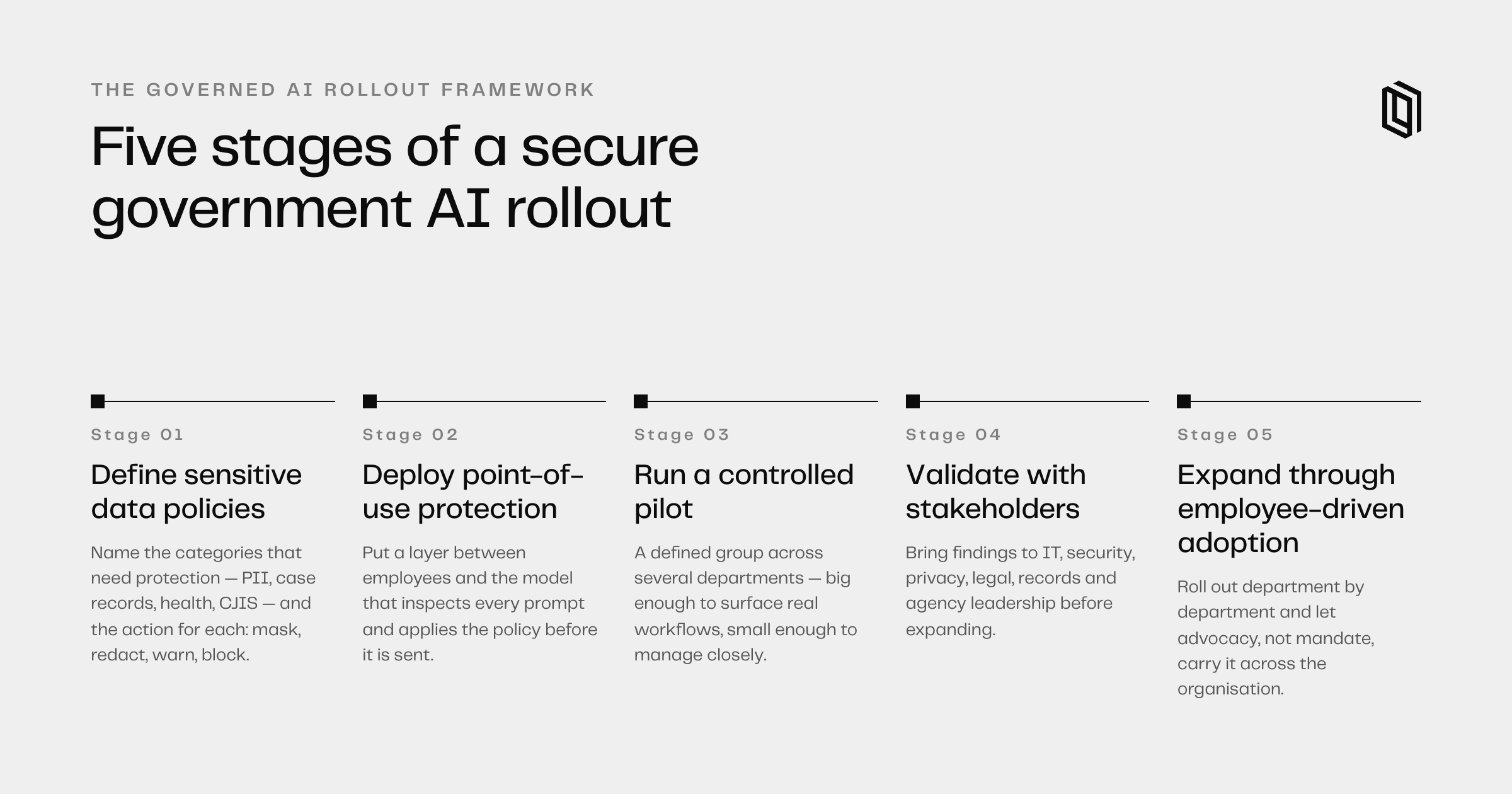
Stage 1: How do you define sensitive data policies for government AI use?
Before deploying any AI tool, identify the categories of information that require protection and decide how each should be handled.
Common categories in local government include:
- Personally identifiable information (names, addresses, Social Security numbers, dates of birth)
- Case records from social services, child welfare, and adult protective services
- Public health data from county departments and behavioral programs
- Financial and eligibility information
- Law enforcement and criminal justice information
- Student records in county and city school divisions
- Financial account information
For each category, determine the appropriate action: mask (replace with a token and restore later), redact (remove entirely), warn (flag but allow), or block (prevent the prompt from sending). These decisions should be informed by applicable regulatory requirements, including CJIS, HIPAA, and FERPA, as well as by the organization's own risk tolerance.
This takes deliberate work. Prince William County's infrastructure review included working sessions to understand the data flow end to end: what the system recognizes, how it redacts versus masks depending on the use case, and how it behaves across different scenarios. That level of specificity, mapping data types to actions before rollout, is what separates a governed deployment from a reactive one.
Stage 2: What is point-of-use protection for AI prompts?
With policies defined, the next step is putting a protection mechanism between employees and the AI model.
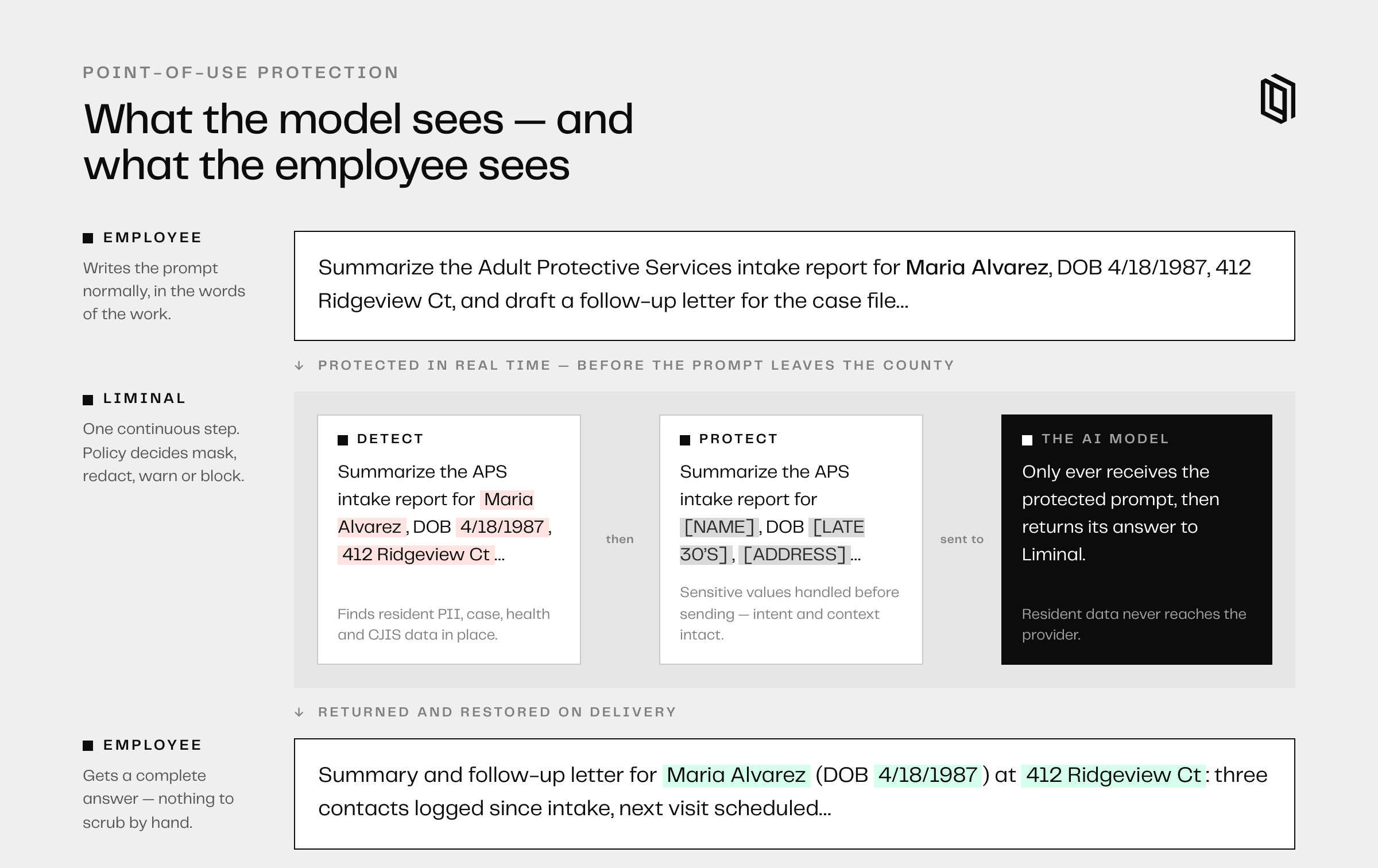
A point-of-use protection layer inspects every prompt before it is sent to the model. When it detects sensitive information, it applies the configured policy: masking, redacting, warning, or blocking. When a response returns, masked terms are restored so the output makes sense in context. The protection operates inside the prompt rather than at the network boundary, which is what allows employees to use AI on real work without manually scrubbing every input.
The goal is to make the secure path the easy path. Employees should be able to use AI for real work, including summarizing case notes, drafting correspondence, and analyzing data, without needing to sanitize inputs by hand.
Consider how this works in practice. An employee in Prince William County's Department of Social Services needs to summarize a report. The platform removes any sensitive and personally identifiable information before sending the prompt to the AI model, then restores that information in the response the employee receives. As Dr. Alicia Hart, the county’s deputy county executive, explained: "That then allows the intent and the context of the prompt to remain, while we are also remaining within compliance."
The employee gets useful output. The data never leaves the organization's control.
Stage 3: How do you run an AI pilot program in local government?
Start with a defined group of users across multiple departments. The pilot should be large enough to surface real workflows and edge cases, but small enough to manage closely.
Select departments where AI offers clear value and where sensitive data is present. Social services, public safety, and HR are natural candidates. These teams deal with high-volume, context-rich work and have obvious use cases for summarization, drafting, and analysis.
Prince William County launched what leadership described as a "soft launch": a pilot phase with 150 users across several departments. Large enough to generate real learnings, controlled enough to course-correct before broader rollout.
During the pilot, gather data on five things: which workflows employees actually use AI for, what types of sensitive data the system detects, whether the protection mechanism behaves as expected, where policies need adjustment, and what friction users report. These findings become the foundation for the next stage: making the case to leadership.
Stage 4: How do you get leadership buy-in for government AI adoption?
Before expanding, bring pilot findings to the people who need to approve enterprise-wide adoption.
This typically includes:
- Information Technology leadership
- Security and privacy officers
- Legal counsel
- Records management
- Agency and department leadership
- Executive management
Present what the pilot demonstrated: usage patterns, data protection performance, policy adjustments made, user feedback, and any incidents or concerns. Address how the deployment meets applicable regulatory requirements.
This is the approach Prince William County's Department of Information Technology took, presenting pilot findings to executive management and agency leadership for their approval before moving forward.
This stage builds organizational trust in the tool and in the process that brought it forward. Rushing it, or skipping it, tends to produce either resistance later or fragile adoption that collapses when a stakeholder raises a question that should have been answered earlier.
Stage 5: How do you scale AI adoption across government departments?
Roll out department by department, but let adoption grow through use rather than mandate.
Communicate through existing channels, with the IT department working alongside internal communications, but prioritize making the tool easy to access and obviously useful. Employees who see colleagues getting value will be more receptive than employees who receive a directive.
Prince William County expanded from its initial 150-user pilot to 20+ departments. But the telling detail is how that growth happened. As Dr. Alicia Hart shared: "The department users have really been the greatest advocates for the product itself. Now they are using it, they are encouraging their colleagues to use it, and eventually we will get to the point where it is an enterprise-wide requirement. But we're doing so in a way that definitely involves our end users and stakeholders and having them at the table."
Early adopters become advocates. Their enthusiasm is more persuasive than any memo.
That is the signal that an AI rollout is working: adoption driven by employees rather than mandated by leadership.
Which local government departments benefit most from AI adoption?
Departments with high-volume, document-heavy workflows see the fastest returns: social services, permitting, HR, public safety records, and constituent services. These teams handle summarization, correspondence, and data analysis daily, and they work with exactly the categories of sensitive information that require point-of-use protection.
That combination is why these departments are the right place to start rather than the risky place to start. The use cases are obvious enough that adoption happens without persuasion, and the data sensitivity is high enough that the protection layer proves its value immediately.
Departments with lower document volume or less sensitive data are easier to deploy but generate weaker evidence. A pilot that avoids sensitive workflows does not demonstrate that the governance model works.
What regulations apply to AI use in local government?
Local governments operate under overlapping regulatory requirements that affect how AI can be used: CJIS for criminal justice information, HIPAA for protected health data in county health and social services, FERPA for student records in school divisions, state public records and FOIA statutes for prompts and outputs, and StateRAMP for cloud service procurement in participating states. A governed AI deployment should address each applicable framework before rollout, not after an incident.
What are the CJIS requirements for AI in law enforcement?
CJIS Security Policy applies to any AI use involving criminal justice information: law enforcement records, booking data, investigative files. This information must remain within controlled environments and cannot be exposed to unauthorized external systems. Point-of-use protection prevents CJIS-regulated data from reaching third-party AI models by detecting and masking or redacting it before the prompt is sent.
How does HIPAA affect AI use in county departments?
HIPAA applies when AI workflows involve protected resident data, common in county health departments, behavioral programs, and social services agencies. Covered entities must ensure this information is not disclosed to AI providers without appropriate safeguards. Masking or redacting protected data before the prompt reaches the model maintains the compliance boundary.
How does FERPA apply to AI in school districts?
FERPA applies when county school divisions or education departments use AI with student records. It requires that personally identifiable information from education records not be disclosed without consent. Point-of-use detection prevents student PII, including names, grades, disciplinary records, and IEP details, from being included in prompts sent to external models. For a fuller treatment, see AI governance and security for education.
Are AI prompts and outputs subject to public records requests?
In most states, AI prompts and outputs created in the course of government business are public records subject to disclosure under state FOIA and open records statutes. This means the content of what employees type into AI tools may be requested, reviewed, and released. The practical implications are twofold. Prompts containing sensitive information create disclosure risk even when the AI interaction itself was governed. And an organization that cannot produce a complete record of AI activity cannot respond to a records request without reconstructing evidence after the fact.
Governments should determine their retention obligations for AI activity before deployment, and ensure the platform logs interactions in a form that satisfies those obligations. Legal counsel and records management should be involved in stage one, not after the first request arrives.
These requirements share a common thread: sensitive data needs to be protected before it reaches an external system, and AI activity needs to be recorded in a form that satisfies disclosure and audit obligations. Point-of-use protection with complete logging addresses both.
Frequently asked questions
How do I prevent employees from entering sensitive data into AI tools?
Deploy a point-of-use protection layer that detects sensitive information in prompts before they reach the AI model. This allows employees to use AI for real work while ensuring protected data, including PII, case records, and public health data, is masked or redacted automatically based on policies you define.
Technical enforcement is what distinguishes this from a policy approach. A policy tells employees what not to do. A protection layer makes the compliant action automatic, which removes the dependence on individual judgment under deadline pressure. See how Liminal detects and protects sensitive data.
Can local governments use commercial AI models like ChatGPT or Claude?
Yes, if access is governed through a platform that applies the organization’s data protection policies before prompts are sent. This enables use of leading models without exposing sensitive resident data to those providers.
The alternative approaches both have costs. Blocking commercial models pushes usage to unmonitored personal accounts. Allowing direct access sends resident data to third parties without controls. A governed access layer preserves model choice while keeping the data boundary intact. Liminal provides unlimited governed access to the latest models from Anthropic, OpenAI, Google, and other leading providers through a single platform.
What is the difference between masking and redacting sensitive data in AI prompts?
Masking replaces sensitive terms with placeholder tokens that preserve context, then restores the original values in the response. The AI model never sees the real data, but the employee receives output that makes sense. Redacting removes sensitive terms entirely, useful when the information is not needed in the response or when policy requires complete removal.
The choice is use-case dependent. Summarizing a case file usually calls for masking, since the output is unusable without the names restored. Drafting a general policy document calls for redaction, since the sensitive details were never needed.
How long does a government AI pilot typically take?
Timelines vary, but a well-scoped pilot can run in 60 days or less. The key variables are defining data protection policies upfront, selecting appropriate departments, and having clear criteria for what success looks like before starting.
Pilots that run long usually do so because policy definition was deferred. Organizations that complete stage one before launching tend to finish the pilot on schedule, because there is nothing left to negotiate mid-flight.
How do we maintain public trust while using AI in government services?
Be transparent about where AI is used and what safeguards are in place. A governed deployment that protects resident data at the point of use gives leadership a defensible answer when constituents or oversight bodies ask how their information is being handled.
Publishing an inventory of AI use cases, and the protections applied to each, converts a question that sounds defensive into one with a documented answer. Trust is easier to maintain than to rebuild.
How do we handle AI adoption when different departments have different data requirements?
Define policies by data type, not by department. A governed AI platform lets you apply different protection rules to different categories of information, so social services, public safety, and HR can all use the same tool with policies tailored to their data.
Department-based policy creates two problems. It applies the wrong controls when a low-risk department handles a high-risk record, and it fragments the deployment into parallel configurations that drift apart over time.
How can public-sector organizations make AI adoption work?
Secure AI adoption in local government requires removing the tradeoff between enabling employees and protecting data. Make the protected path the default, so employees can focus on the work.
The organizations succeeding are the ones that deployed protection at the point of use, started with a controlled pilot, brought stakeholders along through validation, and let employee experience drive adoption. That is the Governed AI Rollout Framework, and Prince William County’s deployment demonstrates it end to end: define policies, protect data before it reaches the model, run a real pilot, validate with leadership, and scale based on results.
When the secure option is the one employees actually want to use, AI starts doing what it should: making public-sector work more effective, without compromising the data residents have entrusted to government.
Ready to explore what governed AI adoption could look like for your organization? Request a demo.