Liminal detects PHI, PII, PCI, and intellectual property in prompts and files in real time, protects it according to your policies, and restores redacted details in the response so the work stays useful.
You have a duty to safeguard the sensitive data in your care. Once it's sent to a model, how it's stored, retained, or used is no longer up to you. Liminal protects PHI, PII, PCI, and intellectual property at the moment of use, before any prompt reaches a model, and restores redacted details in the response. Your organization can embrace AI without compromising on security.
Liminal automatically detects and protects sensitive data before it ever leaves your environment, then restores redacted details on return, so your people get a complete response.
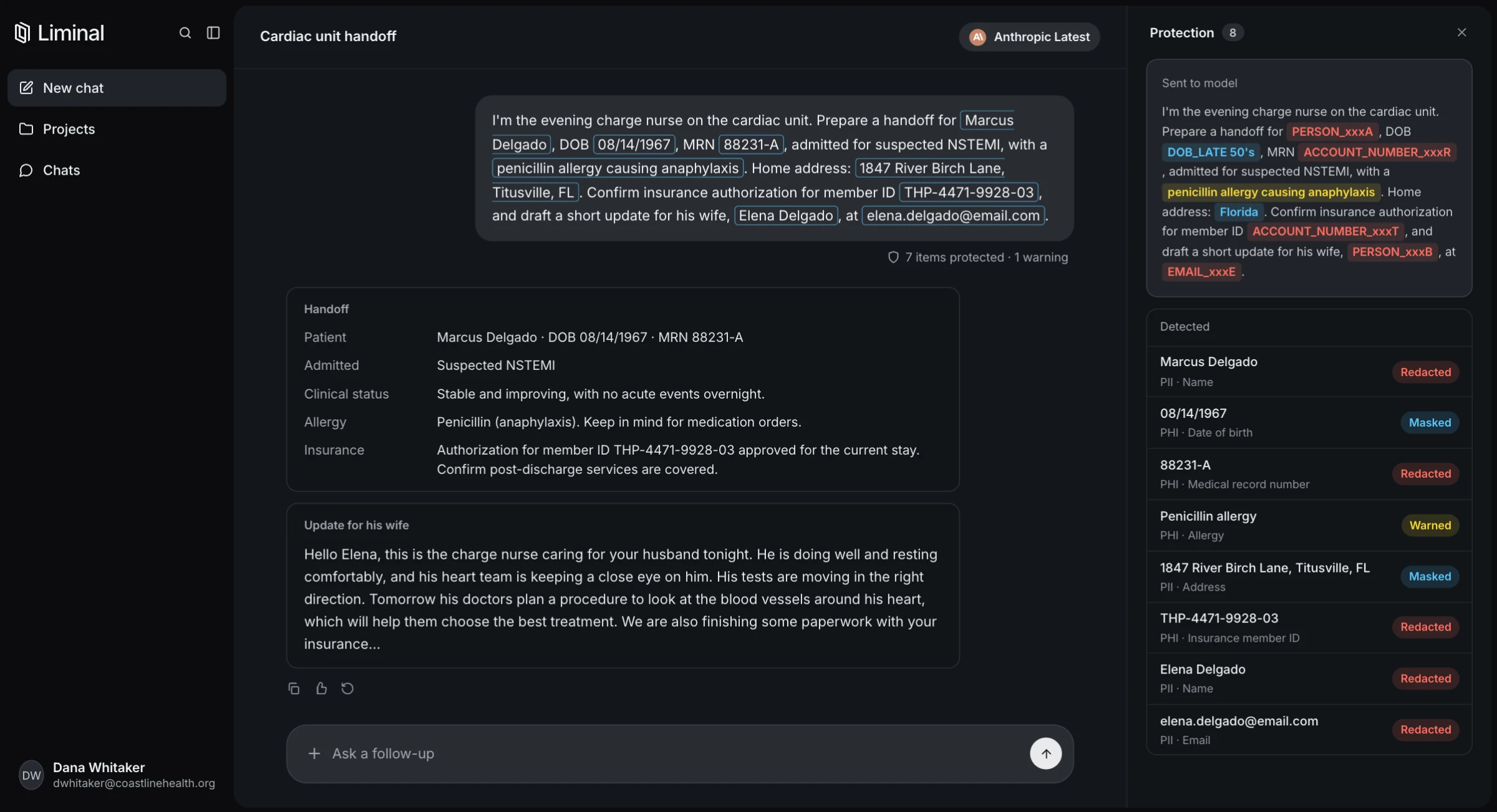
Liminal identifies PHI, PII, PCI, and intellectual property in every prompt and file, in real time.
Security policies are applied to detected data according to the granular controls you set.
Redacted details are restored in the response, so the output is complete and ready to use.
Building your own AI applications? The Liminal SDK brings the same protection to them.
Each detection and policy decision is logged, so security and compliance teams can see what was protected and why.
Redaction replaces sensitive values with consistent placeholders and restores the originals in the response. Masking generalizes a value, such as turning an exact age into an age range, and keeps it generalized. Both are set by policy.
PHI, PII, PCI, and intellectual property, across more than two dozen built-in data types. You can also add your own terms, such as client names or trade secrets.
PHI, PII, PCI, and intellectual property are protected before any prompt reaches a model, according to the policies you set.
Yes. Policies are set by data type for each model, and each model can be assigned to the whole organization, specific teams, or individuals.
Tell us about your team and we'll show you how Liminal fits your environment.
